Choosing between Adobe Animate, Google Web Designer, and Foldwrap starts with the work waiting on your desk. An existing FLA library, an interactive Google campaign, and a set of approved Figma frames are three different starting points.
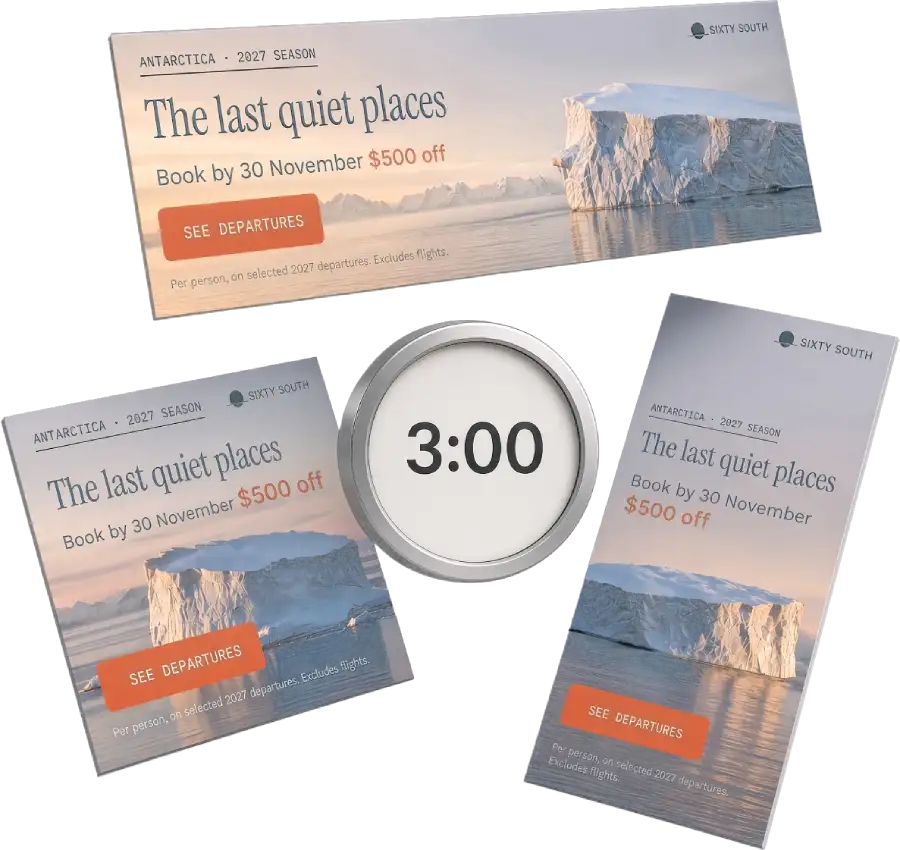
Here we use our fictional Antarctic cruise campaign, to compare the three workflows. You can play the same 970×250 creative from each tool and download the actual exports. The question is which workflow suits your next campaign, including its sizes, revisions, and delivery requirements.
Disclosure: I build Foldwrap. The recommendations below distinguish what we measured from the features each tool offers. Package sizes were checked on October 2026;
Which tool should you choose?
| Your next job | Start by evaluating | Why |
|---|---|---|
| Update an existing Animate campaign with working templates and scripts | Adobe Animate | Keeping the editable source and established production setup can save a rebuild. |
| Build responsive or interactive ads with dynamic feeds | Google Web Designer | Its responsive rules, data bindings, events, and code editor address these requirements directly. |
| Turn approved Figma layouts into an animated set for review and delivery | Foldwrap | Import the layouts, refine an automatic animation draft, and copy motion between matching layers. |
| Produce occasional banners with no software subscription budget | Google Web Designer | Its free desktop authoring is a useful starting point; budget your production and QA time separately. |
These recommendations concern HTML5 display ads. Character animation, games, and general animation production need a different evaluation.
Animate remains available in maintenance mode, with security and bug fixes but no new features. See Adobe's current FAQ or our Animate status guide for that question.
One campaign, three live exports
Sixty South is an internal example campaign. The brief combines a photographic background, brand mark, headline, itinerary, price, booking offer, CTA, and legal copy. Foldwrap's version is our reference creative; the Animate and GWD versions interpret the same design and message sequence.
All three previews below are 970×250 pixels, scaled equally to fit this page. Replay each to compare layout, typography, entrances, holds, and the final offer. They are separate builds: timing, easing, and rendering can differ.
The downloads are the original supplied ZIPs. The embedded previews reuse our comparison-page assets: Animate matches its ZIP; GWD adds a source comment; Foldwrap's preview omits an unused special-case animation branch present in its ZIP. All byte measurements below come from the downloadable packages.
Compare the production workflow
| Production step | Adobe Animate | Google Web Designer | Foldwrap |
|---|---|---|---|
| Starting artwork | Existing FLA, imported assets, drawing tools | Imported assets or templates | Supported Figma frames or an editable example |
| Animation authoring | Timeline, keyframes, tweens, scripting | Quick scenes or Advanced timeline | Automatic draft, then presets, timing, and keyframes |
| Additional sizes | Adapt the source with your templates and workflow | Responsive layouts using media rules | Separate size variants; import designed sizes or resize and refine |
| Reusing motion | Existing symbols, templates, scripts | Author within the document and its layout rules | Copy motion to matching layers; review matches and distances |
| Dynamic content | Depends on your implementation | Data bindings and dynamic workflow | Generate separate variants from pasted data on eligible plans |
| Review | Publish previews through your chosen workflow | Browser preview and file sharing | Share a side-by-side campaign preview |
| Output in this comparison | Canvas and CreateJS | HTML/CSS, GWD components, Studio Enabler | HTML/CSS and GSAP |
| Working environment | Desktop, Adobe subscription | Free desktop application | Browser workspace, paid plans |
Google documents GWD's animation, responsive layouts, dynamic workflow, and code editing. Adobe documents its HTML5 Canvas publishing workflow. The output row describes these particular files; export environments and publishing settings matter.
Starting from approved artwork
For this campaign, Foldwrap started with all required sizes already designed in Figma. The Figma plugin brought those frames into editable variants. That is valuable when recreating approved layout is a recurring part of your workload. Check imported typography, effects, and image crops before animating.
If your editable master already lives in Animate, keeping it there may be cheaper than rebuilding it. Foldwrap does not open FLA files or translate their timelines and scripts. GWD projects also need rebuilding to move into Foldwrap.
Animation and additional sizes
Animate gives an experienced operator a familiar timeline and reusable source material. GWD offers visual animation authoring alongside direct HTML, CSS, and JavaScript editing. Foldwrap starts the animation for you, then leaves timing and keyframes editable.
Size production is a consequential difference. GWD's responsive approach lets layout rules adapt a unit. Foldwrap stores individual size variants; they may come from already designed frames or a resize operation that you refine. Neither approach removes the need to inspect each delivered size.
In the Sixty South Foldwrap build, Motion Copy reused timing across matching layers. Two differently cropped photos needed their own keyframes. The rebuild walkthrough shows that process and the complete size set.
What the three ZIPs actually contain
These measurements are reproducible: download each ZIP, inspect its archive size, then sum the sizes of its unpacked files. KB = 1,000 bytes. External libraries and fonts are excluded from both totals.
| Export measurement | Adobe Animate | Google Web Designer | Foldwrap |
|---|---|---|---|
| ZIP bytes | 415,414 | 402,828 | 35,780 |
| Unpacked bytes | 482,900 | 449,815 | 53,251 |
| Files inside ZIP | 3 | 2 | 3 |
| Main image bytes | 398,052 PNG sprite sheet | 382,483 PNG | 28,394 JPEG |
| Externally loaded dependencies | CreateJS | Studio Enabler + Google Fonts | GSAP + Google Fonts |
Foldwrap has the smallest package in this set. Most of the unpacked difference is image data. These figures do not prove that GWD or Animate must produce a 400 KB banner. Different image encoding, resolution, and publish settings change the result.
The Animate build used version 24.0 build 5, 60 fps, spritesheet export, and hosted libraries. GWD's HTML identifies version 16.4.1.0219 and the gwd-dv360 environment. Foldwrap used its general-usage preset. The exports therefore represent existing production examples, rather than a controlled test of the same platform preset or minimum achievable weight.
ZIP weight is also different from total network transfer. All three packages request external resources, and caching and compression affect actual downloads. We have not measured a comparable three-way network total here.
For a real delivery, select the required export environment, check click tracking and external assets, and consult the platform specification catalogue. The HTML5 ZIP validator helps inspect a package against published checks; passing those checks does not guarantee platform acceptance.
What happens at the first client revision?
Imagine this request: “Change the price, hold the CTA longer, and send the revised sizes for review.” The practical evaluation is how much work that creates in your source documents.
- Animate: edit the source copy and timeline, apply the change through your existing size documents or templates, then republish. A mature reusable setup can matter more than starting a new banner quickly.
- GWD: edit the text and animation, inspect responsive rules or separate documents, then publish for the required environment. Check any dynamic bindings before replacing values directly.
- Foldwrap: edit the affected content and timing, copy revised motion where appropriate, inspect each variant, and refresh the exported delivery. A shared preview helps compare the set, but it is not a comments or approval system.
This is an evaluation checklist, not a timed revision experiment. In particular, Motion Copy is an explicit operation: later timeline edits require another copy and a check of the result.
Our earlier build recorded 1.5 hours for one Animate size and 3 minutes for the Foldwrap set from already prepared Figma layouts. GWD production time was not recorded. Those starting conditions are different, so we do not use them to rank all three tools by speed. The timed walkthrough and its qualifications are available separately.
When is Foldwrap worth paying for over GWD?
GWD is a credible choice when its authoring model fits your work. Foldwrap's case is strongest when importing approved layouts, preparing repeatable motion, reviewing size sets, and delivering exports consume time on every campaign.
Evaluate the subscription against your complete production cycle: initial build, all requested sizes, a client revision, review, and final QA. Include the time spent correcting an import or resize. Do not assume that a quick first animation means a cheaper finished campaign.
For occasional jobs or a well-established GWD template library, switching may offer little benefit. For recurring Figma-based campaigns, test one representative set in Foldwrap and compare the effort with your current process. Use current Foldwrap pricing when making that calculation.
For migration details, the Adobe Animate alternative hub explains the Foldwrap fit and rebuild offer. If GWD is your starting point, see the Google Web Designer alternative comparison for its specific migration boundaries.
Download the comparison files
Use the same files shown above to inspect the creative in your own environment:
- Foldwrap: 970×250 HTML5 ZIP.
- Adobe Animate: 970×250 HTML5 ZIP and FLA source.
- Google Web Designer: 970×250 HTML5 ZIP and editable project ZIP.
Keep working archives in their original tool. Use the next active campaign to evaluate a new workflow, with its real delivery brief and required revisions.
Start with one real campaign
Bring the banner set.
We’ll rebuild it with you.
We’re confident Foldwrap can speed up your banner production. But learning a new tool takes time and mental effort, even when it makes the work easier. Bring a set you already made in Animate. We’ll help rebuild its animation, sizes, and export settings in Foldwrap.
What to bring
- Source artwork and any editable design files
- A preview of the animation you want to recreate
- The required sizes and destination ad platform
You keep the editable master, .foldwrap source file and exported files, whether or not you continue with Foldwrap.
Have approved Figma designs?
See the Figma import workflow ↗
Frequently asked questions
Should I use Adobe Animate or Google Web Designer for HTML5 banner ads?
Start with the editable source and delivery requirements. Animate can make sense for an established FLA library and existing templates or scripts. Evaluate Google Web Designer for responsive layouts, dynamic bindings, custom interactions, and direct code editing. Test a representative campaign before replacing a working setup.
When should I choose Foldwrap instead of Google Web Designer?
Evaluate Foldwrap when your recurring work starts with approved Figma layouts and needs editable animation, multiple size variants, shared previews, and export. GWD may fit better when responsive rules, live dynamic feeds, or custom interactive components are central to the brief.
Can Foldwrap import Animate or Google Web Designer source files?
No. Foldwrap does not convert FLA or GWD projects, timelines, scripts, events, or data bindings. Reuse source artwork or supported Figma frames and rebuild the animation. Keep the original source files for archive edits.
Does the smaller Foldwrap ZIP prove it always exports lighter banners?
No. It is the smallest of these three supplied packages, but most of the unpacked difference is image data. Image resolution, encoding, export settings, and external dependencies affect the comparison. ZIP size alone is not total network weight.
Were all three tools timed on the same task?
No. The earlier walkthrough recorded one Animate size and a Foldwrap set with every layout already prepared in Figma. GWD production time was not recorded. This article compares workflows and supplied files without claiming a three-way speed ranking.
Can I upload these three sample ZIPs to the same ad platform unchanged?
Do not assume so. The GWD sample targets DV360, Foldwrap uses a general-usage preset, and Animate publishes HTML5 Canvas. Configure the intended environment and check click tracking, external resources, dimensions, and platform requirements before delivery. A file-size check does not guarantee acceptance.